
Using the Lippitt-Knoster Model to Create Sustainable Social Change
Introduction:
Managing complex change is no small feat. Whether your organization is shifting direction, restructuring programs, or launching something brand new, the stakes are high—and so is the emotional energy behind it all.
Youʼve got smart, passionate people, a clear purpose, and maybe even a great plan.
So why do so many well-intentioned change efforts fall short?
The answer often lies in whatʼs beneath the surface—the things that are harder to see from the inside.
The Lippitt-Knoster Model: A Framework for Sustainable Change
When it comes to managing complex change, good intentions and a strong mission aren’t always enough. The Lippitt-Knoster Model offers a practical, compassionate framework to help organizations identify whatʼs needed for meaningful, lasting transformation.
This model builds on early organizational change theory developed by Dr. Mary Lippitt in the 1980s, which emphasized leadership alignment and communication. In the late 1990s, Tim Knoster expanded on Lippittʼs work to create a more visual, actionable model for education and nonprofit leaders managing complex system changes. The result is a widely used framework that breaks change management into six critical components for success.
Note: While youʼll see variations of this model floating around the internet, the version we use is grounded in both Lippittʼs original theory and Knosterʼs practical application in complex, collaborative systems.
This model outlines six essential elements that must be in place for change to truly take hold:
- Vision – A clear and shared picture of where youʼre headed. Without it, people feel confused about what the goal actually is.
- Consensus – True buy-in and alignment across teams. Without it, unresolved tension can lead to sabotage, even when unintentional.
- Skills – The tools, knowledge, and capacity your team needs to succeed. Without them, even committed people may feel anxious or ill-equipped.
- Incentives – The personal “why” that motivates individuals to engage. Without meaningful incentives, youʼre likely to encounter resistance.
- Resources – The tangible support—time, funding, staff, materials—needed to act on the vision. Without resources, progress stalls and people feel frustrated.
- Action Plan – A concrete, step-by-step path forward that outlines who does what, and when. Without one, change efforts often suffer from false starts.
Each of these elements play a crucial role in making change possible and sustainable. If even one of these is missing, change can stumble—or stall completely.
Pull Quote: “When just one element is missing, it doesnʼt just slow down progress—it shapes how people feel about the change.”
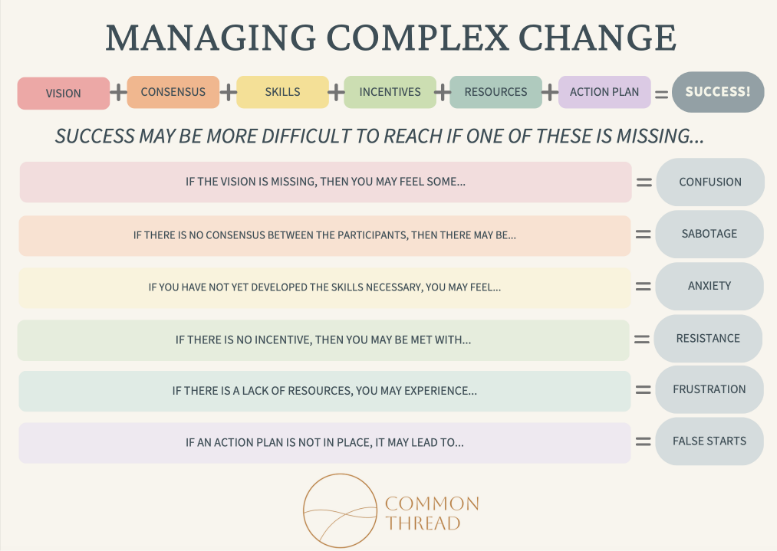
Why Each Piece of the Puzzle Matters
Each component plays a distinct and necessary role. When all six are present, teams feel equipped, empowered, and aligned—and that’s when real progress becomes possible.
Pull Quote: “When every piece is in place, teams feel equipped, empowered, and aligned. Thatʼs the difference between spinning your wheels and making real progress.”
Week 1: Letʼs Talk About Consensus
Consensus isnʼt just agreement on paper. Itʼs a felt sense of ownership. Itʼs when everyone is not only aware of the change but also invested in making it succeed.
From the inside, it can be easy to assume you have consensus—especially if no one raises objections. But in our experience, people often donʼt feel safe enough to voice their hesitations—or theyʼre simply unsure how their perspective fits into the larger picture.
Thatʼs where an external, neutral partner becomes invaluable.
How Consensus Building Works: A Structured, Inclusive Process
When we talk about building consensus, weʼre not suggesting a loose or informal agreement. Consensus is a structured, intentional process designed to ensure that every voice is heard—and that everyone feels safe and empowered to participate meaningfully.
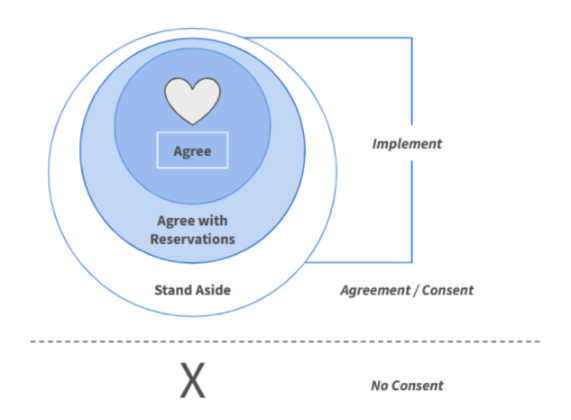
Hereʼs a look at a typical adoption process via consensus:
- Share the Idea or Proposal: First, the idea or plan is clearly shared with the group. Members are encouraged to ask questions, raise concerns, and share their perspectives to build shared understanding.
- Check for Agreement: After discussion, each person in the group indicates their level of agreement by choosing one of the following:
- Agree: “I support this idea.”
- Agree with Reservations: “I can live with this idea, but I have some concerns.”
- Stand Aside: “I donʼt love it, but I wonʼt block it.”
- No Consent: “I cannot support this idea.”
- Decide What to Do Next: If all members either Agree, Agree with Reservations, or Stand Aside, the group moves forward with the idea. If anyone expresses No Consent, the group pauses to discuss concerns, make adjustments, or explore alternatives until broader alignment is reached.
- Move Forward Together: Once consensus is reached—meaning even if not everyone agrees enthusiastically, no one actively opposes—the group proceeds with action, grounded in a shared commitment to the decision.
Pull Quote: “Consensus doesnʼt mean unanimous enthusiasm—it means collective ownership and a commitment to move forward together.”
Why Outside Perspective Matters
When Common Thread comes in as a partner, we bring a fresh set of eyes, and a readiness to hold the space needed to engage in deep listening. Weʼre not bound by organizational history, internal politics, or past assumptions. Instead, weʼre focused on surfacing the truth of where things are now, and helping you build the trust and alignment needed to move forward with confidence.
Pull Quote: “As neutral partners, we help organizations name whatʼs unspoken—so they can build true alignment, not just surface-level agreement.”
We believe in working alongside your team, not over them. Our job isnʼt to tell you what to do—itʼs to create the conditions where your best thinking can rise to the top, and where every voice feels respected and heard.
Whatʼs Next in This Series
Over the next few weeks, weʼll explore each element of the Lippitt-Knoster Model—what it looks like when itʼs working, what happens when itʼs missing, and how we support organizations in bringing all the pieces together.
Because change doesnʼt have to be overwhelming. With the right supports in place, it can be
energizing, strategic, and deeply rewarding.
Work With Us
If your organization is navigating change—or preparing for it—weʼd love to support you. Whether you need facilitation, strategic planning, or a thought partner who can bring clarity and warmth to the process, weʼre here to help.
Letʼs make change that lasts—together. Contact us to learn more about how we can support your next big step.
Additional Resources
Articles
“Systems Thinking & Sustainability,” by Sabrina Popin
Sabrina Popin discusses how systems thinking can be used to help shift our mindsets to create products and services that do good for the world and to help us better navigate the complexities of the socio-political and natural ecosystems in which we live.
TED Talks
Margaret Heffernan – “Dare to Disagree” (TED Talk, 13 min)
An insightful exploration of the power of disagreement and inclusive dialogue in driving progress, aligning with the principles of consensus-building.
Books
“The Art of Facilitation” by Dale Hunter, 2009.
An essential read for those involved in facilitating participatory decision-making within collaborative environments.
Podcasts
Insights at the Edge – “Beyond Hope and Fear” with Margaret J. Wheatley
In this episode, Margaret Wheatley discusses how to navigate uncertainty and build collective will, offering insights into systems thinking and collaborative leadership.
